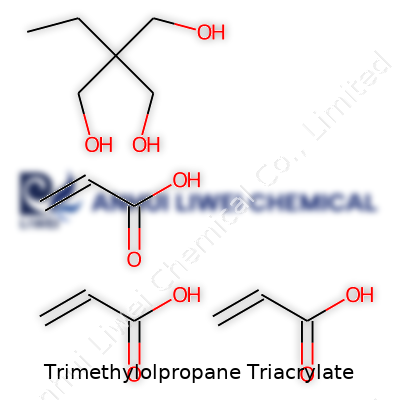
Trimethylolpropane Triacrylate: A Practical Dive
Historical Development
Trimethylolpropane triacrylate (TMPTA) grew out of the industrial search for versatile monomers that could boost coatings, adhesives, and plastics. Chemists looked for ways to make crosslinking easier and to push performance. Over time, TMPTA emerged as a staple due to its unique combination of a trifunctional core and robust acrylate end groups. In the seventies, as UV-curable systems took off, demand soared, and TMPTA production scaled up accordingly. Factories in Europe, Asia, and North America established their own synthesis methods, tinkering with catalysts and purification steps. The dial between innovation and mass-market adoption turned steadily as downstream industries recognized what this monomer could offer.
Product Overview
Commercial TMPTA appears as a clear, oily liquid. Handling it, you’ll notice the acrylate odor, a sign of its reactive double bonds. Suppliers typically offer it in large drums, and companies rely on sealed packaging to limit exposure to air and moisture. From small custom batches for research to bulk orders meant for industrial plants, the supply chain revolves around reliable quality—active ingredient content, color, and water content all matter as buyers set specifications based on the final use. TMPTA stands as one of those chemical intermediates traders keep tabs on, because the price and purity both affect downstream product success.
Physical & Chemical Properties
TMPTA carries a molecular weight of about 296.32 g/mol. It flows easily at room temperature, with viscosity staying under 100 mPa·s for most grades—this property matters in high-speed printing and coating lines. Its boiling point reaches nearly 400°C, though practical processing happens far below that. The density hovers around 1.1 g/cm³. Its chemical backbone, thanks to the trio of acrylate groups, reacts quickly with free radicals. Chemists appreciate its reactivity in polymerization, especially in UV-cured and electron-beam cured technologies. TMPTA dissolves in most organic solvents, so it blends with other monomers, oligomers, and additives used in formulating paints and adhesives.
Technical Specifications & Labeling
Any buyer looking for TMPTA wants to see a certificate of analysis showing acrylate content, acid value, and color (APHA or Gardner scale). Purity above 95% is a must for industrial uses; for medical or optical applications, specs run even tighter. Water content should stay below 0.2% to keep reactions predictable. Drum and tote labeling includes hazard symbols, CAS number 15625-89-5, UN number for transporting hazardous goods, manufacturer batch, and date of production. Transporters and receivers both rely on these details to keep operations safe and regulatory bodies satisfied.
Preparation Method
Production of TMPTA involves esterification of trimethylolpropane (TMP) with acrylic acid. Large reactors, often stainless steel, anchor the process, where TMP and acrylic acid react in the presence of an acid catalyst. To drive the reaction forward, water formed during the process gets removed, sometimes under vacuum or using a Dean-Stark setup. Afterward, the reaction mass passes through a washing and neutralization stage to pull out unreacted acids and catalyst residues. Distillation rounds out the purification, targeting high-purity product ready for shipment. Manufacturers pay keen attention to controlling side reactions, such as polymerization during storage, so inhibitors like hydroquinone often get added in tiny amounts before final drum filling.
Chemical Reactions & Modifications
TMPTA’s value comes from its three acrylate groups. Under UV or electron beam irradiation, these double bonds swing into action, launching radical-driven curing or polymerization. Researchers have experimented with partial substitution—swapping one acrylate for a methacrylate or adding other pendant groups—to shape performance. The acrylate chemistry responds well to thiol-ene coupling, Michael addition, and other modification routes. In thicker sections, TMPTA can promote rapid curing and tougher networks when mixed with lower-functionality monomers. Its backbone can serve as a foundation for hyperbranched or dendritic polymers too, putting TMPTA at the center of smart material development, from lens coatings to microelectronics.
Synonyms & Product Names
Every industry has its naming quirks. TMPTA goes by several names: 2-Propenoic acid, 2-ethyl-2-[[(1-oxo-2-propenyl)oxy]methyl]-1,3-propanediyl ester, or sometimes just “Trimethylolpropane triester of acrylic acid.” Big chemical houses—BASF, Sartomer, Arkema—list trade names like Sarbox 300, Sartomer SR351, or TMPTA 99. Some catalogs refer to it as Trimethylolpropane triacrylate, others opt for TMP triacrylate. Industries working with dental products will see it referenced as a crosslinker or reactive diluent. Familiarity with synonyms smooths out ordering, regulatory checking, and safety documentation.
Safety & Operational Standards
Safety drives every decision in a production plant or lab using TMPTA. Direct skin contact can cause irritation, and inhaling vapors irritates respiratory tracts. OSHA and European agencies require gloves, goggles, and lab coats. Good ventilation cuts down vapor buildup, especially during scale-up reactions. Material safety data sheets flag TMPTA as a mild sensitizer, with repeated exposures tied to skin allergies. Storage tanks and drums avoid heat and direct sun. Fire risk stays moderate, so operators rely on grounding equipment to avoid sparks and keep ignition sources far from workspaces. Emergency steps include shower stations, eyewash bottles, and protocols for small spills, focusing on containment and safe disposal.
Application Area
Industry players in coatings, inks, and sealants count on TMPTA for crosslinking power. High-gloss flooring, protective car finishes, printed circuit boards, and pressure-sensitive adhesives all trace performance back to this trifunctional acrylate. In dental products, TMPTA boosts polymer matrices for longer life and better wear resistance. Optical lens manufacturers use it for scratch-resistant, high-refractive coatings. Graphics companies count on TMPTA in fast-curing inks for high-speed presses. The trend toward eco-friendly, UV-curable systems keeps TMPTA front-and-center—less solvent emission and faster cure cycles make it good for plant efficiency, regulatory compliance, and worker safety. Makers of 3D printing resins and microelectronics also lean toward TMPTA to build tight, robust polymer networks with predictable curing times.
Research & Development
Researchers chase new ways to exploit TMPTA’s reactivity, mixing it with bio-based monomers or using nanofillers for enhanced coatings. In academic labs, scientists often probe the impact of TMPTA’s structure on polymer film toughness, elasticity, or clarity. R&D projects dig into green chemistry, searching for renewable TMP sources or low-toxicity process routes. Startups and mature players alike keep bench chemists busy, developing hybrid formulations with TMPTA as a key ingredient to push beyond the limits of conventional acrylates. The focus lands on speed-to-cure, mechanical resilience, and sustainable lifecycle design.
Toxicity Research
Safety and toxicity questions around TMPTA shape regulatory debate. Animal studies point to low acute toxicity, yet repeated skin contact or long-term inhalation can trigger allergies or chronic effects. TMPTA’s acrylate groups can sensitize skin, a concern for workers. Toxicologists regularly test TMPTA for gene mutations or effects on embryo development, and results keep finding their way into chemical hazard databases. Regulatory frameworks like REACH or the EPA’s TSCA require regular review as new data roll in. Researchers in the field follow all trends in dermal absorption, air emission, and biodegradability, trying to untangle TMPTA’s impacts in real-world manufacturing and disposal environments.
Future Prospects
Looking ahead, TMPTA faces both opportunity and scrutiny. Its spot in UV-cure and advanced coating markets looks strong, especially as more industries push for quick, solvent-free production cycles. Bio-based and non-toxic variants will steer R&D spending. Pressure from regulators and brand owners may push producers to tighten control of impurities and stray byproducts. Collaborations with academic labs and start-up innovators could drive novel hybrid materials featuring TMPTA at the core—lighter, tougher, and designed for recycling. The industry’s focus on sustainable processing and green chemistry will play a big role. Those who keep their operations clean, their research sharp, and their communication transparent stand a good chance of seeing TMPTA grow into new markets, far beyond where it started.
Inside Everyday Materials
Trimethylolpropane triacrylate goes by TMPTA in manufacturing circles. It seems like an obscure chemical, but for anyone who walks on a freshly cured hardwood floor or handles a sturdy smartphone case, TMPTA has probably made an unrecognized appearance. This substance sits in many modern plastics, resins, and paints because it helps harden and crosslink molecules—giving products strength while keeping weight and material use down.
I remember stepping into a print shop a few years ago. Behind the counter, an array of vivid signs and labels lined the shelves. Ultraviolet-cured inks brought that slick, permanent finish to each design. These UV-cured materials often use TMPTA. It improves curing speed, keeps printed layers from smearing, and ensures lasting color. Signs in public spaces, safety labels, and even packaging all benefit from the robust finish this chemical helps create.
Driving Change in Manufacturing
TMPTA seems almost tailored for industrial use. It appears in adhesives, coatings, and composites wherever manufacturers demand a fast, durable result. Take fiber-reinforced plastics in automotive or aviation—TMPTA boosts the hardness and chemical resistance while letting light-weight resins replace heavier metals. As industries push for low-VOC and low-emission processes, UV-curable chemistries powered by TMPTA outpace traditional solvent-based approaches. These formulations skip the hazardous fumes and long drying times.
This shift matters beyond the shop floor. Quick-curing, low-emission technologies lower workplace hazards and cut energy demands. According to the European Chemical Agency, using TMPTA in controlled UV-curing systems helps companies meet stricter environmental and safety rules, reducing waste in the process. Such shifts ripple out into consumer products, where fewer toxins and improved durability matter to buyers—especially in toys, electronics, and food packaging.
Roadblocks and Health Concerns
Not every use story fits a rosy picture. Scientific studies highlight potential skin sensitization and irritation risks for workers handling TMPTA, so gloves and proper extraction remain crucial in plant operations. The American Conference of Governmental Industrial Hygienists has flagged safe handling guidelines. I’ve seen production managers run scheduled training just to keep exposures low. Even with modern engineering controls, the risk of accidental spillage or improper storage stays present. Reports from chemical safety agencies show that workers new to the field face higher accident rates when companies skip regular training or put off equipment checks.
Long-term, the industry concentrates on substitution and automation. Robotic mixing and automated UV-curing lines cut down on direct contact, saving workers from skin exposures. Also, green chemistry researchers chase alternatives offering the same toughness as TMPTA but with less potential for harm. Some newer plant-based acrylates have entered trials, but matching TMPTA’s performance at large scale still brings technical and cost hurdles.
Pushing Forward
TMPTA already plays a big role in bridging quality and efficiency needs across manufacturing. Its versatility keeps it in favor today, but steady improvements in workplace training, protective gear, and safer substitute research will determine if the next decade stays reliant on it or moves into new territory. Anyone buying durable plastic or painted goods—whether building materials or consumer tech—has a stake in how these changes play out, both at the factory and on the shelves.
Understanding Trimethylolpropane Triacrylate
Trimethylolpropane triacrylate usually shows up in manufacturing environments, especially those dealing with plastics, coatings, and adhesives. This colorless or pale-yellow liquid acts as a building block for everything from dental fillings to flooring finishes. Few people outside the chemical business know the name, yet thousands of workers encounter it each day.
The Health Concerns
Trimethylolpropane triacrylate doesn’t belong anywhere near your skin, eyes, or airways. My own time on factory floors taught me this lesson quickly: just a few hours handling acrylate compounds could mean dry, itchy hands and a dose of caution. Researchers have linked this compound with skin irritation, eye damage, and allergic reactions. Many who work around it for months develop “sensitization”—your immune system suddenly treats the chemical like an enemy, which can cause rashes and asthma-like symptoms.
The science backs up those everyday observations. The European Chemicals Agency labels trimethylolpropane triacrylate as a skin and eye irritant, and also as a “sensitizer”, which means repeated exposure will aggravate allergies. Breathing in its vapor can cause headaches or dizziness. The U.S. National Library of Medicine flags accidental spills or leaks as dangerous, since the chemical can soak through gloves or contaminate air quickly.
Long-Term Impacts
While the data on cancer risk remains uncertain, nobody has ruled it out. The way trimethylolpropane triacrylate interacts with living tissue raises red flags. Several studies suggest that repeated or prolonged exposure can damage kidneys, liver, or nerves. I’ve met production workers pushing through shifts with headaches, sore throats, or unexplained fatigue—symptoms that fade once protective measures improve.
Protecting Workers and Consumers
The dangers don’t mean throwing out the compound entirely. Instead, the focus settles on how companies handle it. Good ventilation makes a big difference—pulling fumes away before anyone breathes them. Gloves and goggles keep splashes off skin and out of eyes. In Europe, employers must provide chemical safety training and up-to-date Safety Data Sheets, so staff understand both the risks and the best ways to keep safe.
For those working at home with commercial glues or resins, it pays to read product labels and keep rooms aired out. Washing hands thoroughly after any project, even one that “dries fast,” avoids accidental transfer to eyes or mouth.
Product Safety and Safer Alternatives
As a community, we need more research into safer alternatives that deliver the same performance without the health drawbacks. Biobased additives are arriving, but switching over takes time and investment. As new data appears, both regulators and companies should push to replace the more harmful ingredients, even if change doesn’t come overnight.
No one needs to panic around trimethylolpropane triacrylate, but no one should ignore its impact on real people, either. Keeping health front and center leads to stronger rules, safer jobs, and better products.
Tough Resins That Don’t Quit
Paint and coatings manufacturers use Trimethylolpropane Triacrylate, known in the industry as TMPTA, to make paints and varnishes that stand up against scratches and sunlight. Unlike some older resins, TMPTA forms a dense network that delivers a tougher finish. You’ll find it in automotive refinishes and floor coatings. The quick-drying feature saves workshop time, while the hardened surfaces mean less need for frequent touch-ups.
Printing Inks for Fast-Paced Production
Print shops demand speed. TMPTA shows up in many UV-cured inks, enabling rapid curing under lamps. Anyone running a large commercial press knows that the ability to stack or pack materials within seconds means higher output and fewer bottlenecks. This quality appeals to everything from magazine publishers to label makers. The compound’s chemistry allows for bright, sharp images and durability even on flexible packaging.
Better Adhesives in Manufacturing and Construction
A lot of companies making adhesives for wood bonding, electronics, or crafts depend on TMPTA for its bonding power. Once exposed to UV or electron beams, the adhesive sets in moments and won’t budge after that. This matters for manufacturers assembling furniture components or microchip producers needing precise, resilient attachment of minuscule parts. TMPTA’s resilience holds up under pressure and heat, keeping failures to a minimum.
3D Printing and Modern Prototyping
The world of 3D printing changes every year. Some 3D printers use photopolymer resins, and TMPTA sits right in the mix. Because it cures quickly under UV light, it makes rapid prototyping possible. Makers enjoy shorter turnaround times and detailed prints with crisp edges. I’ve seen prototype gears and even jewelry molds come out of these machines, ready for testing within hours.
Electronics and Printed Circuit Boards
Printed circuit board makers look for materials that offer strong insulation and reliability. TMPTA enters the fray in solder masks and insulating layers. Its dense, cross-linked structure lets electronics survive higher temperatures and constant mechanical stress. Fewer faults mean longer-lasting devices and fewer returns.
Meeting Safety Standards and Environmental Demands
Any chemical that ends up in widespread products draws scrutiny. TMPTA isn’t exempt. While robust and effective, safety teams need to manage exposure risks during handling. Responsible companies have improved ventilation, automation, and protective gear for workers. Regulatory bodies monitor emissions and workplace exposure to limit health issues.
Looking Forward: Pushing for Greener Solutions
As more countries adopt tighter regulations for chemicals and waste, researchers tackle the challenge of developing bio-based or less hazardous acrylate systems. Innovations focus on renewable feedstocks and safer formulations, a push driven not just by compliance, but by industry demand for eco-friendly labels. Many customers choose paints and adhesives with a lower environmental footprint, steering manufacturers toward change.
Final Thoughts
Trimethylolpropane Triacrylate powers durable products in sectors from flooring to electronics. Standing in a hardware store aisle or browsing new gadgets, most of us don’t think about these connections, yet TMPTA’s performance turns up in plenty of places beyond the lab. The push for greener, safer alternatives shows that technical progress goes hand in hand with responsibility.
Understanding the Substance on the Shelf
Trimethylolpropane Triacrylate, often called TMPTA, makes appearances in the manufacturing of plastics, adhesives, and coatings. Those who have handled it know it is not something to treat lightly. It stands as a flammable, reactive liquid that gets unhappy with heat, sunlight, or any stray spark. I remember a warehouse job where two drums of TMPTA sat next to a window. The sun came out, things heated up, and the supervisor dashed over with a thermometer. We learned fast how quickly things can start to feel risky.
Straightforward Storage: Shade, Temperature, and Airflow
Safe storage starts with a cool, dry, and well-ventilated space. I have seen operations lock TMPTA away in metal safety cabinets or storerooms, keeping it away from doors that swing open into sunlight. Anything above room temperature pushes the stability of the liquid. Heat transforms safe storage into an emergency response. No good ever comes from a temperature spike—spills and container bulges can lead to even bigger problems.
Sunlight matters too. UV rays can push TMPTA into unwanted chemical reactions. A clerical mistake once left a drum near a sunlit window for two days, and the quality control team had to throw out the batch. Even if people forget sometimes, TMPTA never does. Shelter it from any direct light. Shade keeps things predictable.
Security and Segregation: No Shortcuts
I have found that storing TMPTA alongside acids, bases, or oxidizers invites trouble. One small leak can start a cascade of chemical reactions. Setting aside storage space for only similar materials makes tracking much easier—no surprises, just inventory with paperwork that lines up. I once saw a new hire line up TMPTA with strong oxidizers, thinking all liquids go together. A seasoned worker caught it, flagged the mistake, and moved the containers. It gave us a chance to remind everyone in the plant that familiarity can lull you into carelessness.
Containers Matter More Than People Think
Keeping TMPTA in factory-sealed, tightly closed containers prevents leaks and limits its contact with air. Fresh air, dust, or moisture creeping in starts the clock on unwanted changes in the liquid. I once pried open a corroded metal drum and saw clear evidence that poor sealing means ruined stock and extra disposal headaches. Metal containers, lined with materials that won’t react with TMPTA, give peace of mind. Plastic drums labeled for acrylates serve as good alternatives.
Sensible Solutions for Real-World Risks
Monthly checks on storage areas catch trouble before it starts. Training everyone who works with TMPTA on what the labels, symbols, and protocols mean saves lives. Substituting with less hazardous alternatives only makes sense if a process allows it. For many companies, the risk comes with the business, so making safety routine—not just an afterthought—stays on the front burner.
Proper storage does not count as a one-off task. The routine of checking ventilation, temperature, security, and chemical compatibility builds habits that prevent emergencies and costs. Every container tells a story—whether it’s of care or corners cut. That’s the real difference maker.
Understanding the Substance
Trimethylolpropane Triacrylate, or TMPTA, pops up in quite a few places. From industrial coatings to inks and adhesives, people run into it more often than they realize. It’s a colorless liquid, but don’t let its meek appearance fool you. TMPTA can cause skin irritation, has links to respiratory discomfort, and triggers allergic reactions in some workers. The potential risks demand respect and careful handling.
Direct Hazards: What Can Happen on the Job?
Several years ago, I watched a co-worker underestimate what a splash of TMPTA could do. Within minutes, red blotches spread across his arms. He ended up missing the rest of his shift, looking like he’d tangled with poison ivy. The lesson hit home—protective gear saves skin and sanity.
Anyone who’s spent time in old paint shops will agree: breathing in strong fumes or having chemical-laden hands at lunch rarely ends well. TMPTA vapors can irritate lungs, and some cases tied extended exposure to asthma-like symptoms. NIOSH and OSHA give exposure limits for good reason. It isn’t just bureaucratic checkbox checking—these numbers come from real workplace incidents.
Gloves, Goggles, and Real Barriers
The basics start with gloves that stand up to chemicals, splash-proof goggles, and lab coats or coveralls that cover as much skin as possible. Thin, dollar-store gloves or regular reading glasses leave gaps for accidents. Chemically resistant nitrile gloves and sturdy safety eyewear offer real protection. Once, I saw someone try to “tough it out” barehanded. A few drops later, he spent hours in a wash station—all avoidable.
TMPTA doesn’t have a strong smell, but that creates its own problem. No harsh odor means few realize they’re breathing in unsafe amounts. Good ventilation—fans, fume hoods, local exhaust systems—pulls those vapors away before they reach lungs. In small or makeshift spaces, a simple open window won’t cut it. Proper ventilation separates safe shops from regretful ones.
Clean Work Habits and Spills
Chemicals don’t care about breaks or distractions. Leaving open containers, skipping cleanups, or getting lazy with hand washing leads to contamination that rides home on skin or clothes. Washing up right after handling TMPTA matters—before eating, before touching anything else. Spill kits need to stay stocked, with absorbent material designed for hazardous liquids and a clear set of instructions posted where folks can see them. I’ve watched panic spread faster than the spill when nobody knew where the kit was stored.
Training and Respect: The Real Foundation
Factory rules that come from real managers talking to real workers stick around for a reason. Training isn’t a throwaway day. Each refresher keeps best practices fresh, just like fire drills. Everyone deserves to know how to work safely—nobody likes an emergency they don’t know how to handle. Engineers, janitors, and shift leads should all follow the same rules. In my experience, teams that swap safety stories, review incident reports, and bring up close calls during meetings build habits that protect everyone. TMPTA isn’t going anywhere, so the safeguards around it shouldn’t either.